
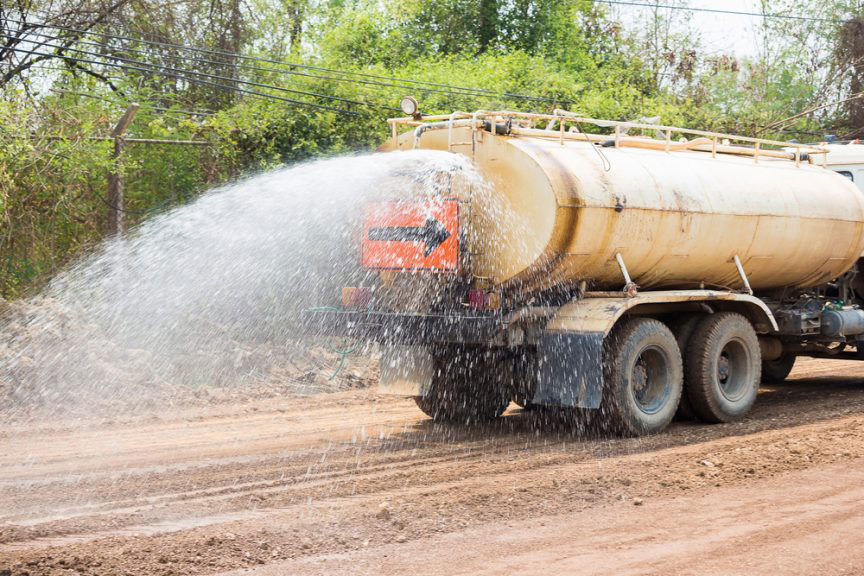
Dust control for roads comes down to three practical choices: a fully managed program where a specialist handles everything, a guided self-apply program where your crew runs expert-grade equipment and chemistry, or an enhanced watering program that upgrades the resources you’re already hauling. Selecting a program that suits your site depends on how much labor, equipment, and compliance documentation you want to maintain in-house.
Deciding on dust control for your roads matters more than ever. Watering alone was once an acceptable answer, but with OSHA’s Respirable Crystalline Silica Standard, EPA fugitive dust rules, and the sheer cost of running water trucks around the clock, “just add water” is rarely the whole answer anymore, especially on high-traffic haul roads, laydown yards, and production roads where dust is both a compliance issue and an operating cost.
Program, Not Product: Built Around Your Site, Not Off a Shelf
A packaged dust suppressant applied the same way on every site is a guess dressed up as a solution. Traffic volume, load weight, road base material, climate, and compliance requirements are different on every gravel road, haul road, or dirt road, and a one-size-fits-all product doesn’t account for any of it.
Midwest builds dust control for roads as a program, not a product. That starts with a Discover, Diagnose, Design, and Deliver process that looks to understand what is actually happening on your specific roads before recommending a chemistry, a concentration, or an application schedule. A quarry road running loaded haul trucks all day needs a different plan than a rural production road that sees a handful of vehicles a shift, even if both are technically “gravel roads.”
That’s also why there are three programs instead of one. Managed Service, Guided Self-Apply (GSA), and Enhanced Watering are different ways to deliver the same underlying approach to the chemistry of dust control for roads and a schedule matched to your site’s real traffic and conditions, all adjusted for how much of the work you want to run yourself.
The Three Programs, Side by Side
| Program | Who does the labor | Who owns the equipment | What Midwest provides | Best fit |
| Managed Service | Midwest | Midwest | Product, application, scheduling, monitoring, compliance support | Limited internal staff, complex sites, strict compliance requirements |
| Guided Self-Apply (GSA) | Your crew | Your vehicles + Midwest’s sprayer | EnviroKleen chemistry, portable sprayer, training, ongoing technical support | Want control and flexibility, comfortable with hands-on application |
| Enhanced Watering | Your crew | Your water trucks | DustPro Super Dilution Technology additive, application plan, field trial support | Already have a watering program worth keeping, want better results from it |
In plain terms: Managed Service means Midwest does it for you. GSA means you do it yourself with the support of Midwest’s product, equipment, and training. Enhanced Watering means you keep your trucks and your people, and Midwest makes the water itself do more.
Managed Service: Midwest Does It For You
A Managed Service program is the option for facilities that would rather not build in-house expertise related to dust control for roads. Midwest’s Field Application Specialists handle delivery, scheduling, application, inspections, and reporting, so a plant manager or EHS lead doesn’t have to.
There are two versions of this program, and the difference matters for anyone weighing it against a compliance requirement:
- Full Service covers everything, including air quality permitting and compliance support, monitoring, data collection, recordkeeping, and annual reporting. This is the version built for sites that need assistance producing documentation for OSHA, EPA, or state and local regulators.
- Turnkey Service covers delivery, application, scheduling, and basic recordkeeping, without the deeper data collection and compliance support layer. It suits sites with simple or minimal permitting requirements that mainly want reliable, hands-off application related to dust control for roads.
The performance case for this approach isn’t just internal marketing. A U.S. EPA and iron and steel industry study measured Midwest’s product controlling more than 90% of PM10 and more than 75% of PM2.5 on active haul roads at two steel plants, 30 days after application. Separately, a year-long study by the Desert Research Institute and the California Air Resources Board tested seven dust suppressants head-to-head on public unpaved roads and found Midwest’s chemistry sustaining 98% dust control at three months, 95% at six months, and 90% at a full year, while also reducing surface deterioration like potholes and washboarding.
For gravel road dust control on mine haul roads specifically, one customer treated 28 kilometers of haul road under a Managed Service program and maintained over 95% dust control while saving more than a million liters of water annually in Arctic conditions.
Guided Self-Apply: You Run It, We Equip It
GSA is the do-it-yourself path to dust control for roads, but it’s not a product sale. Midwest provides EnviroKleen, a synthetic organic dust suppressant built around KleenBinder technology, along with the 1500 Portable Sprayer that turns a pickup or flatbed into an application vehicle, plus hands-on training and ongoing technical support.
Your team runs the applications on your own schedule using your own vehicles. Midwest’s role is making sure the chemistry, the equipment, and the application plan are right for your specific dirt or gravel road conditions. Our team then remains available as you scale the program from a single test area to full-site coverage.
This matters for dust control on dirt roads and gravel roads where conditions vary. A four-year case study at a steel producer’s laydown yard achieved and maintained over 85% dust reduction using a fully in-house GSA program that included a sprayer modified to run off the site’s own forklift and 24/7 technical support for the crew running it.
GSA tends to fit sites that want direct control over timing and cost, are comfortable with hands-on application, and don’t need assistance with the compliance reporting layer.
Enhanced Watering: The Same Trucks, Smarter Water
Enhanced Watering is the option for sites that already have a watering program, but want to make it work as a more effective form of dust control for roads. Midwest’s DustPro Super Dilution Technology is a highly concentrated additive, powered by NanoLoc technology, that is incorporated to each load of water you spray.
The practical effect: watering frequency that used to run six to 10 applications a day can drop to one or two, cutting water use by roughly 75% and freeing up 50% to 70% of water truck man hours. Unlike plain water, which evaporates and offers no lasting benefit, DustPro SDT builds what Midwest calls “ground inventory,” meaning each application adds to a cumulative effect that improves performance and road durability over time rather than starting from zero with every application.
This is a strong fit for dust control on roads where the watering infrastructure, trucks, drivers, and routes, already exist and work well operationally. The upgrade is in the chemistry, not the process. It’s also a way to maintain compliance, since predictable, documented results are easier to stand behind than the statement “we watered it today” ever was.
Which Dust Control Program Fits Your Roads?
A few questions tend to sort this out quickly:
- Do you have the internal staff to run applications yourself? If not, Managed Service removes that burden entirely.
- Do you need to produce compliance documentation for a regulator? Full Service Managed programs are built for that. GSA and Enhanced Watering can still support compliance, but the data collection and recordkeeping is reliant on your internal team.
- Do you already have a watering program and equipment you like? Enhanced Watering upgrades what you have instead of replacing it.
- Do you want direct, hands-on control of when and where dust control happens? GSA gives you that, backed by Midwest’s chemistry and training.
- Is this a single high-traffic road or an entire multi-site network? All three programs scale, but Managed Service is generally the strongest fit for complex, multi-area sites.
None of these dust control for roads options are permanently locked in. A site can start with a GSA trial on one problem area, prove the results, and expand it, or start with Enhanced Watering and move to a full Managed Service program as compliance requirements grow.
Answers to Your Frequently Asked Questions
What is the best dust control for gravel roads?
It depends on how much labor and equipment you want to run yourself. For high-traffic gravel roads like mine haul roads or production roads, a Managed Service or GSA program, using an engineered chemistry like EnviroKleen, outperforms watering alone, both in dust reduction and reduced road maintenance.
What is the difference between dust control and dust suppression?
Dust suppression is usually a single action or product application, like spraying water once. Dust control, on the other hand, is an ongoing program with a defined plan, schedule, and measurable results.
Does OSHA’s Respirable Crystalline Silica Standard apply to unpaved roads?
Facilities with unpaved roads and yards that generate respirable dust can fall under OSHA’s silica rule depending on the aggregate and regular traffic volume. A site-specific assessment is the right first step in developing dust control for roads, and it’s exactly what Midwest’s Discover and Diagnose process is built to do.
What’s the difference between a managed dust control service and a self-apply program?
In a Managed Service program, Midwest’s own specialists handle delivery, application, scheduling, and data collection. In a Guided Self-Apply (GSA) program, your own crew performs the applications using Midwest’s chemistry, equipment, and training.
Can I start with one dust control program and switch to another later?
Yes. Many sites start small, testing a GSA program on one problem area or adding Enhanced Watering to an existing water program, then scale up to a full Managed Service program as needs or compliance requirements grow.
How much water can a dust control program for roads actually save on dirt roads?
Enhanced Watering programs typically reduce water use by around 75%, while Managed Service and GSA programs using EnviroKleen can eliminate the need for daily watering altogether since the chemistry doesn’t wash out and doesn’t rely on constant reapplication.
Ready to Fix Your Dust Problem?
Whether you need someone to handle it all, the tools to do it yourself, or a smarter version of the watering program you already run, Midwest has a path to dust control for your roads.
Explore all three dust control programs or request a free consultation to find the right one for your site.