
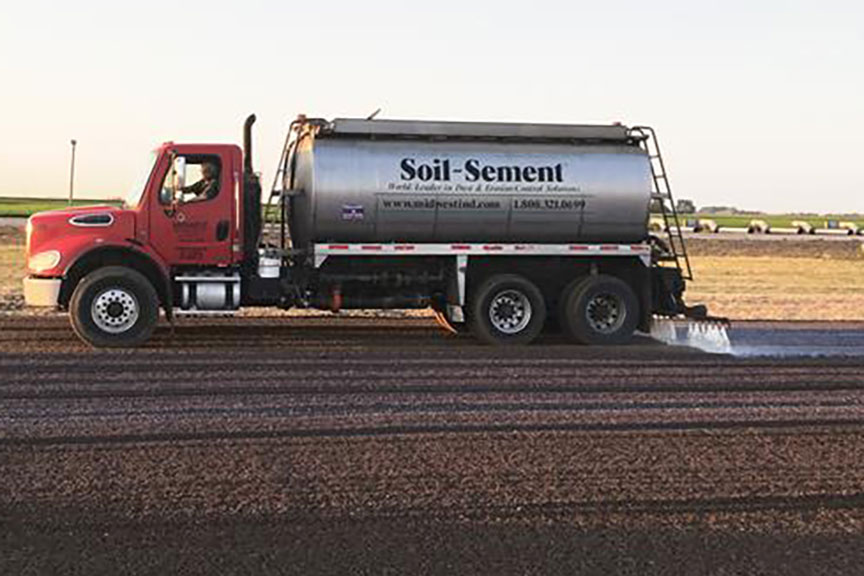
Midwest Industrial Supply has been delivering big results in the world of dust control and soil stabilization technology since unveiling our transformative Soil Sement formula in 1978. Unlike anything that had (or has) existed before, this chemistry-backed solution has been the breakthrough for numerous applications – dust suppression for an entire underground copper mine, soil stabilization for vital roadway networks connecting remote villages, or fines preservation to secure gravel runways that exist in the farthest reaches of northern Canada.
Regardless of the climate, activity level, or aggregate soil composition, Soil Sement remains the undisputed champion, achieving up to 95% dust suppression and up to 40% improvement in load bearing capabilities for roads and runways. Even with big results, the success behind this revolutionary system takes a molecular perspective.
We’re diving deep into the internal performance engine behind Soil Sement known as our Nanoloc™ Molecular Binding Matrix.
Precision Chemistry that Outperforms the Rest
Traditional stabilizers are notorious for their short-term relief and hazardous side effects. Runoff from chlorides, one of the most common methods, can negatively impact vegetation as well as corrode vehicles and infrastructure. Lignins can provide a greener alternative, however, these binding agents are highly water soluble, drastically shortening their working lifespan. Petroleum resins and asphalt emulsions can strengthen durability, but they require complex application plans, high upfront costs, and more environmental concern.
Though dust suppressants and soil stabilizers are ineffective for many reasons, their primary weakness lies in weak chemical bonding. As a result, sites must implement constant reapplication sessions to keep up with products that either wash away or fail, leading to rising maintenance costs and an increase in the presence of particulate matter.
Compared to these temporary fixes, Soil Sement is specifically engineered to address every facet of soil stabilization and dust control through the power of nanotechnology. Where competitor products rely on short molecular chains that span from 100 to 10,000 molecules, Soil Sement incorporates long, high carbon-index polymer chains up to 1,000,000 molecules long. We call these chains the Nanoloc™ Molecular Binding Matrix.
Once applied, these extensive molecule strings interlink to form a flexible, reinforced polymer network. Soil Sement’s Nanoloc network leverages its extraordinary bonding capabilities to lock fine particles to the surface of aggregate with an effect similar to an internal mesh. The resulting Nanoloc Molecular Binding Matrix prevents deterioration, preventing PM10 and PM 2.5.
Engineered for More: Exploring the Nanoloc Binding Matrix
Though applied as a liquid solution over the course of several sessions, Soil Sement is not a simple coating, but a comprehensive stabilization system. Unlike alternatives, which lie only on the surface of aggregate, the Nanoloc Binding Matrix penetrates deeply and evenly into the soil, binding with particulate matter of all sizes to create one, uniform surface that functions like natural aggregate without the typical side effects.
This unique nanotechnology does not alter, but re-engineers the composition of aggregate to generate a plethora of high-value performance benefits. Along with superior durability, the crosslinking matrix resists common sources of wear, including UV interference and water intrusion. Soil Sement’s same polymer network even enhances load bearing capacity for high-traffic applications by improving compressive, tensile, and shear strength. Its ability to evenly stabilize also strikes the perfect balance between stiffness and flexibility for long-term structural stability.
Case Study: Soil Sement Treats High-Traffic Roadways in Oregon
For decades, Soil Sement has continued to provide modern dust control by leveraging advanced polymer chemistry that addresses the shortcomings of traditional solutions and accommodates growing compliance needs. The success of our proprietary nanotechnology has been demonstrated across a broad range of applications, spanning industries, end-uses, and natural environments.
One such case study began on a network of country roads set in Oregon. The local Public Works Department was experiencing extreme road destabilization as a result of heavy traffic related to nearby agricultural operations. During peak season, these roads could endure anywhere from 100 to 250 trucks per day. The accelerated surface degradation and aggregate loss, the region was also facing rising fugitive dust.
The Public Works Department soon realized the ongoing destabilization could not be tackled through frequent grading and repairs due to the county’s limited resources. Looking for a more sustainable solution, the entity turned to Midwest to develop a nanotechnology-based stabilization system that could improve and maintain the impact created by its agricultural traffic.
The custom program began with placing a two-inch base course layer on top of the existing road surface. Next, this layer was stabilized with a dose of Soil Sement incorporated to the upper four inches of the road.
A contracted third-party engineering firm then validated the performance of the roads. The independent group determined Soil Sement and its Nanoloc Binding Matrix generated a 140% increase in initial load-bearing capacity, with average CBR jumping from 38 to 90 within the first month. Even in the face of freeze/thaw cycles, the roads maintained a 115% increase in bearing strength, keeping them reliable through planting seasons and harvest operations.
Together, these improvements culminated in a more than 90% reduction in maintenance requirements for the Public Works Department, including a substantial reduction in fugitive dust emissions, surface degradation, and aggregate loss. Now, resources that would have been used to facilitate roadway upkeep could be repurposed to address other needs.
The success of this country road stabilization program is not singular, but another valuable testament to the power of molecular chemistry. With Soil Sement and its Nanoloc Binding Matrix technology, any operation can sustain stabilized aggregate materials for an enhanced performance, reduced costs, and the near-elimination of particulate matter.
Contact Midwest today to bring modern dust control and soil stabilization that targets native soils from the atomic level.