
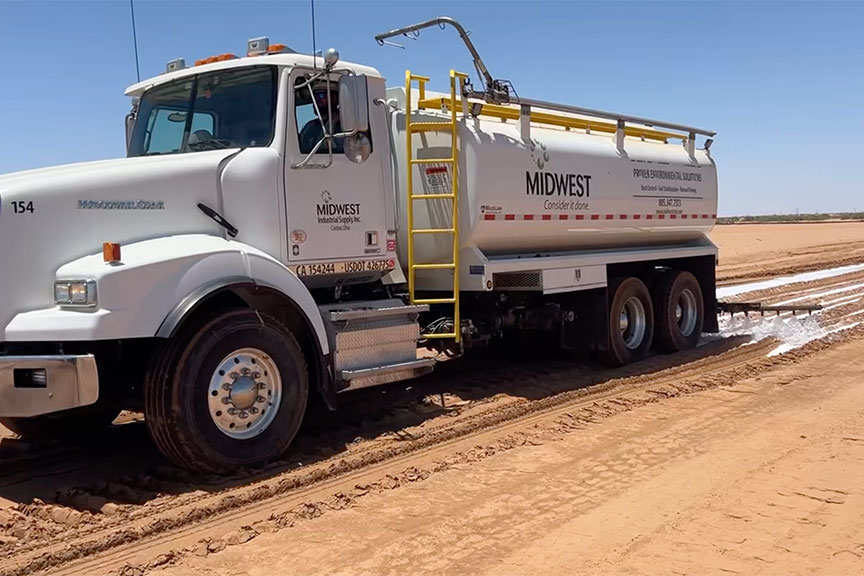
When ground was broken on a major solar construction project covering more than 1,000 acres in southern New Mexico, the engineering team faced a problem that would stop any project cold: the cement stabilization base failed to consistently meet the specified strength requirement.
After testing multiple sections with cement contents ranging from 3 to 8%, the results were maddeningly inconsistent. Despite using conventional Portland cement dosages, these sections failed to reliably meet the required 30 CBR strength. For 17 miles of access roads and 16 acres of laydown yards that needed to support extreme construction traffic, the philosophy of “maybe it’ll work” wasn’t acceptable.
As project delays continued to mount, the fine, sandy A-3 soils, bringing a CBR of only 2.0, left the project searching for an alternative solution more dependable than cement stabilization.
Why Cement Stabilization Falls Short with A-3 Soils
A-3 soils are a unique challenge in stabilization. Composed of fine sands with little to no plasticity, the natural weaknesses of this soil group catches many contractors off guard. Here are several reasons why traditional methods, like cement, fall short when stabilizing A-3 soils.
To start, the pozzolanic reaction that makes cement effective requires clay minerals. A-3 soils lack the clay particles and plasticity index that it depends on, resulting in weak, unpredictable bonds, even with a surplus of cement added.
Particle size distribution also plays a critical role in stabilization. A-3 soils are composed of uniform, fine sand particles, which prohibits them from creating the interlocking matrix that cement stabilization requires. Without sufficient fines and the right gradation, the cement simply coats particles without improving the structure of the soil.
The inadequate stabilization then makes project delays inevitable. When test sections with 8% Portland cement still fail to reliably meet design requirements, construction grinds to a halt. Every failed test means recalculating mix designs, additional testing, and schedule slippage that cascades through the entire project timeline.
For the New Mexico solar project, these challenges meant that traditional cement stabilization – despite being the go-to method for many projects – was not only inadequate, but adding to the list of complications. Every road segment needed to perform consistently to keep the renewable energy development on track. Without a dependable solution, that need remained unmet.
The Performance Data Behind Cement Stabilization vs. Polymer-Based Solutions
The New Mexico construction project team’s experience illustrates exactly why A-3 soils demand a different approach – and what’s at stake in the interim of finding the right solution. After discovering the power of the polymer-based nanotechnology in Midwest’s Soil-Sement Engineered Formula®, the results spoke for themselves.
When using the Portland cement treatment (even up to the 8% threshold), the surfaces failed to achieve the 30 CBR design strength requirements. Not only that, but the site demonstrated inconsistent strength values, even across identical soil conditions. The unreliable performance then resulted in delays and posed safety risks to crew members working on the project.
By comparison, incorporating Midwest’s Soil-Sement Engineered Formula® did more than eliminate the challenges of A-3 soils. In fact, our polymer-based solution not only met the strength requirement, but exceeded it during laboratory testing. CBR values increased from two to 35 – a 1,650% improvement. These improvements resulted in 100% specification compliance across all field installations. An independent testing agency even verified these results across every section of the construction project.
The difference between these solutions wasn’t marginal. It took the project from stalled to the complete stabilization of 17 miles of roads and 16 acres of laydown yards in 21 days.
How Advanced Polymer Nanotechnology Stabilizes A-3 Soils
Rather than depend on clay content or pozzolanic reactions, Soil-Sement Engineered Formula delivers results by leveraging the makeup present in the soil. Once applied, Soil-Sement Engineered Formula coats and binds individual soil particles into a strong, cohesive matrix. These extremely strong bonds create a dense, uniform layer that transforms weak native soils into a structurally sound subgrade.
The stable subgrade then works to provide a solid foundation for the aggregate layer above, distributing loads effectively and preventing deformation from heavy traffic. The layered support system provides immediate strength and long-term durability.
Without reliance on specific chemical reactions and soil minerals, polymer-based, nanotechnology stabilization continually delivers predictable, repeatable results. In the case of the New Mexico construction project, laboratory testing directly mirrored field outcomes, eliminating the guesswork that plagued the cement approach.
Instead, this site was able to stabilize 17 miles of access and maintenance roads, 16 acres of laydown yards, achieving CBR values greater than 30 – in only 21 days. The fast application – and even faster results – meant the construction projects team could resume plans with the infrastructure to handle extreme traffic loads.
Soil-Sement Engineered Formula also introduced several environmental benefits. Aside from an underwhelming performance, alternative methods like cement stabilization can also make a negative impact on the environment, from dust generation to high carbon emissions to disruptions in the nearby environment.
Midwest corrects these drawbacks by intentionally engineering solutions like Soil-Sement Engineered Formula to provide increased performance without environmental risks. Our soil stabilization systems eliminate the need to import suitable materials by relying solely on native soils. In addition, Soil-Sement Engineered Formula’s complex binding process prevents environmental leaching or dust from destabilization.
Ultimately, the New Mexico construction project set a new precedent for renewable energy developments facing similar challenging soil conditions – proving that with the right approach, even the most difficult sites can support large-scale infrastructure demands.
When it’s Time to Implement a Polymer-Based Solution
Polymer stabilization is a game changer for plenty of projects and operations. Even if you’re still weighing options like cement stabilization, projects with certain conditions and requirements can turn polymer stabilization from a serious consideration to an easy decision.
Soil conditions are the easiest determinant for choosing a polymer-based solution like Soil-Sement Engineered Formula. A-3 soils, like the ones featured in the New Mexico construction project, are difficult to stabilize without the right technology. Soils that exhibit CBR values below five, uniform particle size distribution, or a low plasticity index (PI < 10) are also indicators to try a polymer-focused, nanotechnology solution.
Aside from technical details, factors like project requirements can benefit from the fast-acting performance of Soil-Sement Engineered Formula stabilization. Tight construction schedules, large-scale infrastructure needs, extreme traffic loads, performance verifications, and a history of ineffective stabilization methods are strong signals to try a proven, long-term polymer solution.
When the New Mexico solar project team initially needed a stabilization solution, they defaulted to the familiar and readily available tactic of cement. But when field testing revealed it couldn’t reliably perform in A-3 soils, the team faced a decision: accept ongoing delays or find a stronger alternative. They chose the latter, and the results speak for themselves.
As renewable energy development accelerates nationwide, projects will increasingly encounter challenging soil conditions that conventional methods can’t reliably address. The New Mexico solar project demonstrates that polymer stabilization isn’t just an alternative — it’s becoming the preferred solution for sites where performance, schedule, and sustainability all matter.
Facing similar soil challenges? The Midwest geotechnical team has stabilized thousands of sites, ranging in various soil conditions. We can provide a thorough evaluation of your specific soil profile and performance specifications, within your project parameters, to recommend a more reliable and cost-effective solution than methods like cement stabilization. Schedule a consultation to speak directly with our stabilization engineers about your A-3 soil challenges and the ways we can help you achieve superior results in no time.